Ragdoll Colors and Patterns: What Do Seal, Blue, Mitted and Bicolor Mean?
Families looking at available kittens often ask about the difference between Ragdoll colors and patterns. Terms such as seal, blue, colorpoint, mitted, bicolor and lynx may seem confusing at first, but each one describes a different part of a Ragdoll’s appearance.
A kitten’s color tells you the shade of its darker points, while its pattern describes how that color and any white markings are arranged. Once you understand those two parts, names such as “blue mitted” or “seal bicolor” become much easier to recognize.
This guide explains the colors and patterns families most often see at ClassicDoll.
What Is the Difference Between Ragdoll Colors and Patterns?
A Ragdoll’s color refers primarily to the shade visible on the points of the cat:
Face and mask
Ears
Legs and paws
Tail
The body is generally lighter than these areas.
A Ragdoll’s pattern describes how the point color and white markings are distributed across the face, chest, legs and body.
For example, a blue mitted Ragdoll has blue-gray point coloring combined with the white paws and other markings associated with the mitted pattern.
Color and pattern work together to create the kitten’s complete coat description.
Seal and Blue Ragdoll Colors
ClassicDoll kittens are most often seen in two traditional colors: seal and blue.
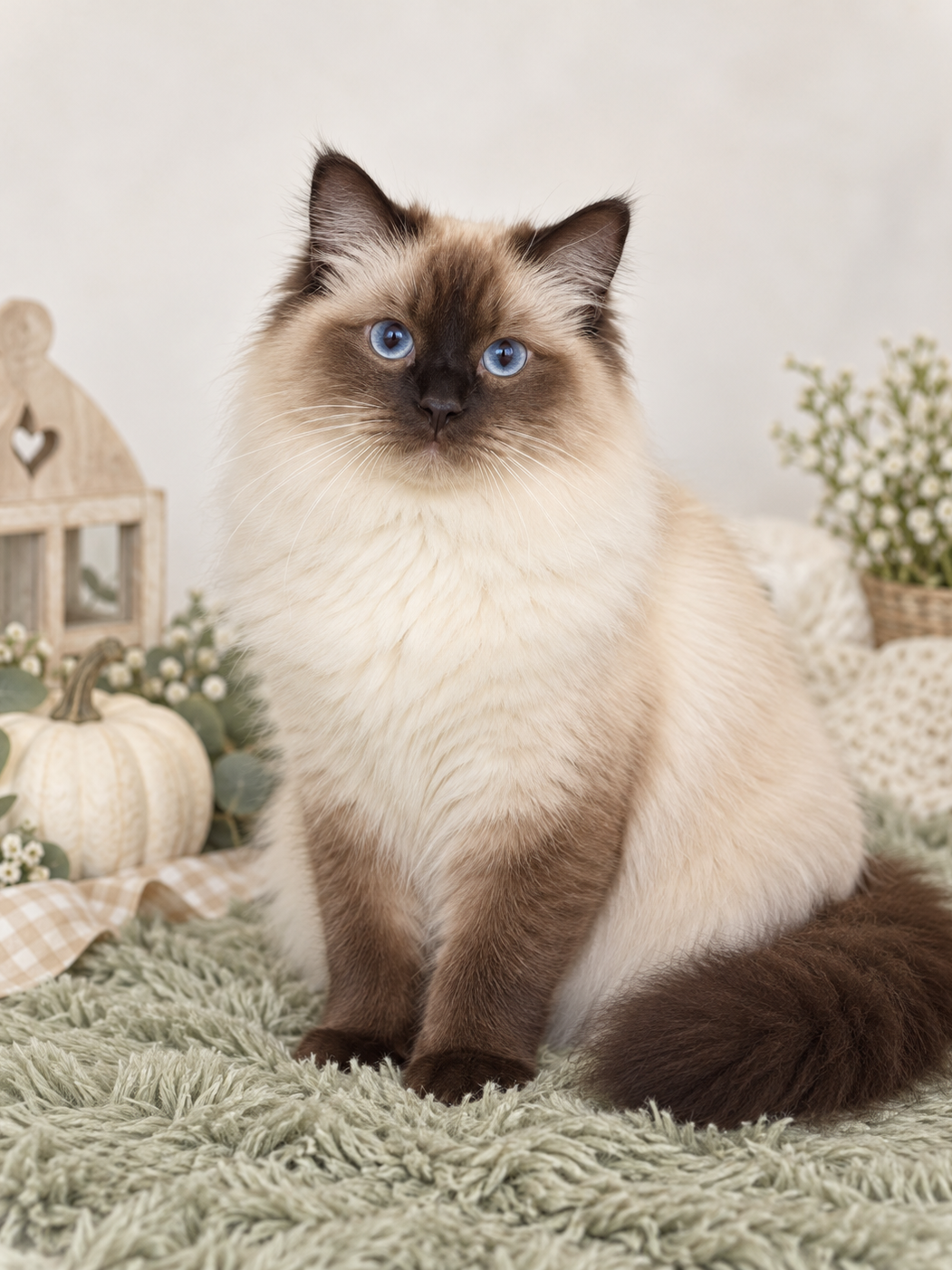
Seal Ragdolls
Seal Ragdolls have deep brown point coloring. Their ears, mask, legs and tail may range from warm brown to a very dark seal brown, while the body remains lighter.
As a seal kitten matures, the contrast between the body and darker points usually becomes more noticeable.

Blue Ragdolls
Blue Ragdolls have cool gray or slate-blue point coloring rather than brown. Their bodies are generally pale, with soft gray coloring developing on the face, ears, legs and tail.
The word “blue” in cat terminology does not mean bright blue. It describes a diluted gray shade with a cool tone.
The Main Ragdoll Coat Patterns
The three patterns families most often see at ClassicDoll are colorpoint, mitted and bicolor. Each pattern has a different amount and placement of white.
Breed registries may use additional classifications and detailed show-standard terminology. This guide focuses on the terms used to describe ClassicDoll kittens and help families understand their appearance.
Colorpoint
A colorpoint Ragdoll has darker coloring on the face, ears, legs and tail, with a lighter body and no white spotting.
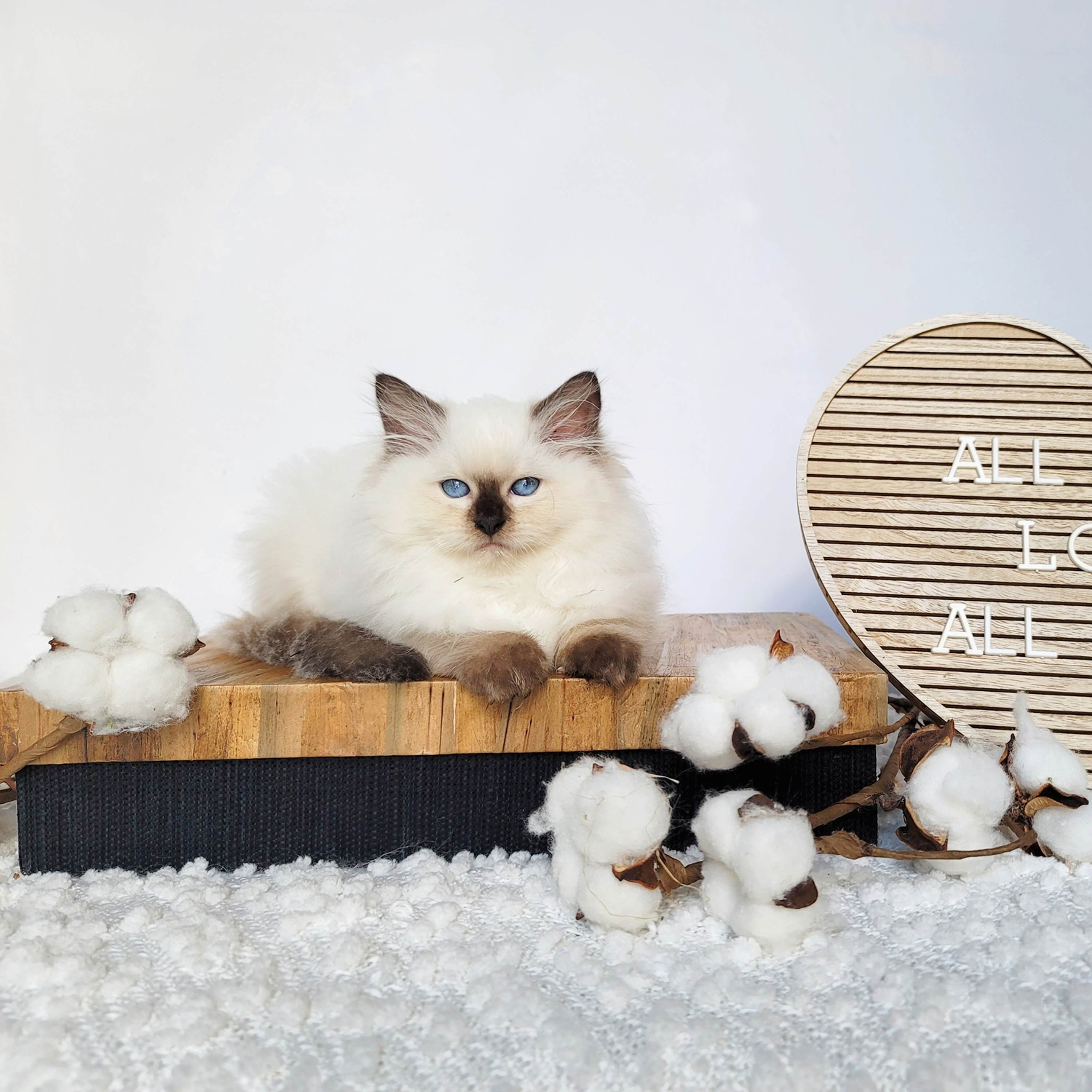
The nose leather and paw pads generally correspond with the cat’s point color. Because there are no white facial or paw markings, the contrast between the pale body and darker points creates the classic pointed appearance.
A colorpoint Ragdoll may be described as:
Seal colorpoint
Blue colorpoint
Seal lynx colorpoint
Blue lynx colorpoint

Mitted
A mitted Ragdoll has point coloring combined with distinct white markings.
Typical mitted features include:
White mittens on the front paws
White boots on the back legs
A white chin
A white stripe along the underside of the body

Some mitted Ragdolls may also have a white blaze on the nose or forehead, although a blaze is not present on every mitted cat.
A mitted kitten may be described as seal mitted or blue mitted depending on the color of the points.

Bicolor
A bicolor Ragdoll has more white than a colorpoint or mitted Ragdoll.
The most recognizable feature is the white inverted “V” on the face. Bicolor Ragdolls also generally have a white chest, underside and legs, with point color remaining on the ears, tail and portions of the face and body.

The size and shape of the facial “V” can vary between individual cats, which gives each bicolor Ragdoll a distinctive appearance.
What Does Lynx Mean in a Ragdoll?
Lynx does not describe the placement of white in the same way as colorpoint, mitted or bicolor. Instead, it describes tabby-like stripes within the colored points.

A lynx Ragdoll may show:
Fine stripes on the face
Lighter markings around the eyes
Stripes on the legs and tail
The characteristic tabby “M” on the forehead
Lynx markings can appear together with different colors and patterns. For example, a kitten may be described as a blue lynx mitted or a seal lynx bicolor.
This is why lynx should not be treated as a replacement for the main pattern. It adds another visual characteristic to the kitten’s color and pattern description.
How to Read a Ragdoll’s Coat Description
Ragdoll coat names usually combine several pieces of information.
The first word identifies the color:
Seal
Blue
The next word may identify a variation:
Lynx
The final word identifies the pattern:
Colorpoint
Mitted
Bicolor
Here are a few examples:
Blue Mitted
The kitten has cool gray point coloring together with white mittens, back boots, a white chin and a white underside.
Seal Bicolor
The kitten has deep brown point coloring with a white inverted “V” on the face and white on the chest, underside and legs.
Blue Lynx Colorpoint
The kitten has cool gray point coloring with visible tabby-like stripes and no white spotting.
Seal Lynx Bicolor
The kitten has deep brown striped points together with the white facial and body markings associated with the bicolor pattern.
Why Can a Kitten’s Color Change as It Grows?
Ragdoll kittens are born very pale, and their point coloring develops gradually. The ears, face, legs and tail become more defined as the kitten grows.
This means a young kitten may look much lighter than the same cat will look as an adult. Color contrast and markings can continue becoming clearer over time.
Photographs of a kitten’s parents and older relatives may help families understand how the kitten’s coloring could develop, but every Ragdoll remains an individual.
Does Color or Pattern Affect Personality?
A Ragdoll’s color or pattern does not determine whether the cat will be affectionate, playful, calm or outgoing.
Temperament is influenced by the individual kitten, genetics, socialization, upbringing and life experiences. Two kittens with the same color and pattern may still have very different personalities.
When choosing a companion, families should consider temperament and compatibility with their household rather than selecting a kitten only because of a particular marking.
ClassicDoll spends time observing each kitten as they grow and can help approved families understand which kitten may be a suitable match for their home and lifestyle.
Choosing Your Ragdoll Kitten
Color and pattern are part of what makes every Ragdoll beautiful, but they are only one part of choosing a new companion.
Explore our available kittens to view their current photos, coat descriptions, personalities and reservation status. If you are unsure what terms such as seal, blue, mitted or bicolor mean, you are always welcome to ask.
